
When a political journalist appears on air with a rounded belly, social media erupts even before she has said a word on the subject. Anne Saurat-Dubois, a prominent figure in political journalism on BFMTV, has been the focus of a wave of online searches regarding her private life for several months. The phenomenon goes beyond mere curiosity: it highlights how women journalists are treated as soon as their bodies change.
Internal charters of newsrooms and pregnancy on air
Before discussing image or career, one can ask a concrete question: what does a newsroom provide when a journalist becomes pregnant? Since 2022-2023, several French audiovisual newsrooms have adopted or strengthened internal charters on pregnancy and parenthood. These measures include protection against being sidelined from the air, the explicit right to choose whether or not to announce a pregnancy, and adjustments to schedules for morning or evening live broadcasts.
The problem is that these charters remain very opaque and are rarely made public. We know they exist through union reports and labor court decisions, but their precise content varies from one channel to another. For a political journalist like Anne Saurat-Dubois, whose work rhythm follows parliamentary crises and election nights, the question of schedule adjustments is far from trivial.
The topic surrounding Anne Saurat-Dubois gaining weight and having a baby illustrates how the general public seizes these subjects long before the individuals involved speak out.
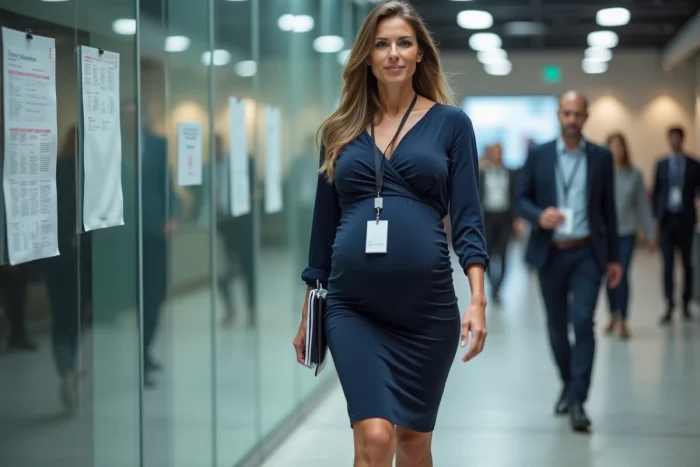
Generational divide on the image of pregnant journalists
Surveys by the Association of Women Journalists (AFJ) reveal a clear divide in public perception. Their focus groups conducted at the end of 2023 show that those under 35 perceive continuity on air during pregnancy as a sign of professionalism. The presence of a rounded belly on screen is seen as a welcome normalization of motherhood in the professional space.
On the other hand, among those over 55, feedback varies on this point. A significant portion of this age group remains divided, even reluctant. We find in online comments old reflexes: remarks about appearance, questions about the ability to handle a live broadcast or maintain the same level of political analysis.
This generational divide is absent from the content circulating about Anne Saurat-Dubois. The focus is on the rumor (“is she pregnant?”) without ever addressing how the public creates its own criteria for professional legitimacy based on women’s bodies.
Maternal glass ceiling in political journalism
On the ground, several of Anne Saurat-Dubois’s female colleagues in political journalism report a specific obstacle related to motherhood. The most exposed positions (political department head, editorialist, election night presenter) are perceived as less accessible to women who become mothers. This observation, documented by the National Union of Journalists (SNJ), is based on decisions from the Paris labor court and testimonies collected during professional training.
Motherhood creates a glass ceiling distinct from that related to gender alone. A woman without children can access an editorial leadership position, but returning from maternity leave often comes with a tacit reassignment to less strategic slots.
The career of Anne Saurat-Dubois, who has managed to assert herself in political journalism against figures like Jean-Luc Mélenchon during heated live exchanges, shows that competence does not automatically protect against these mechanisms. Notoriety can even amplify the phenomenon: the more visible a journalist is, the more her body becomes a subject of public commentary.
Concrete mechanisms of sidelining
We rarely talk about the forms this sidelining takes. Here’s what the affected professionals describe:
- A gradual shift towards subjects considered less “hard” (culture, society) upon returning from leave, even when the journalist covered politics before her pregnancy
- A reduction in the frequency of live appearances in favor of pre-recorded reports, which are less exposed but also less valued internally
- Informal remarks about presumed availability, which weigh in planning decisions without ever appearing in a written document
These situations do not stem from open malice. They are part of a culture of constant availability, inherited from a model where the ideal political journalist is one who can go to the National Assembly at any hour.
Online speculation and journalists’ right to privacy
The volume of Google searches around a possible pregnancy of Anne Saurat-Dubois raises a fundamental question. The status of public figure does not eliminate the right to silence about one’s intimate life. In France, the law protects privacy, including that of media-exposed individuals. Whether or not to announce a pregnancy is strictly a personal choice.
What the speculations reveal is the persistence of a reflex: when a woman physically changes on screen, an explanation related to motherhood is sought before any other hypothesis. Weight gain, fatigue, a change in clothing, everything becomes a clue.
What newsrooms can do concretely
Some levers exist to limit this pressure:
- Make public the main lines of parental charters, which would help cut short speculation about a possible withdrawal from the air
- Train the community managers of the channels not to fuel ambiguity around journalists’ private lives in social media posts
- Systematically integrate a parentality component into collective negotiations, on par with working conditions in conflict zones
The transparency of newsrooms regarding these measures would protect both journalists and the public, shifting the conversation from women’s bodies to the actual working conditions of the profession.
The case of Anne Saurat-Dubois crystallizes a broader phenomenon in the French media landscape. The next step will likely not come from the journalists themselves, but from newsrooms willing to publicly take responsibility for their commitments regarding the place of mothers in political information.