In France, periodic roadworthiness testing covers more than a hundred inspection points, but it only provides a snapshot of the vehicle at a given moment. Between inspections at an approved testing centre, routine maintenance is what determines mechanical reliability and everyday safety.
Dealerships, independent garages and motorists themselves all share this responsibility, within a regulatory framework that has evolved in recent years, particularly regarding the right to use parts from the circular economy and the freedom to choose a repairer.
Car maintenance and the manufacturer’s warranty: what the regulations say
A common misconception persists: having your car serviced outside the approved network voids the warranty. The Directorate General for Competition Policy, Consumer Affairs and Fraud Control (DGCCRF) has clarified the issue. A commercial warranty cannot be made conditional on having maintenance carried out within the approved network for work not covered by that warranty. In other words, an independent garage can carry out routine servicing without the manufacturer being able to refuse to cover a claim.
The condition is that you follow the maintenance schedule set by the manufacturer and keep all supporting documents: itemised invoices, part numbers and details of the work carried out. A well-maintained service record, whether digital or paper, is the only evidence that can be relied upon in the event of a dispute. For more information, Sparh’s car advice covers the key points to watch at every stage of a vehicle’s life.
Having the freedom to choose your repairer can also help you manage costs. Hourly rates can vary considerably between a dealership and an independent garage, and regulations require the VAT-inclusive hourly rate to be displayed, along with an itemised breakdown of parts on the invoice.
Engine fluids and filters: frequency matters more than the task itself
Checking fluid levels is a familiar piece of advice. The real question is how often to check each fluid and which method to use, since the intervals differ.
Engine oil and coolant
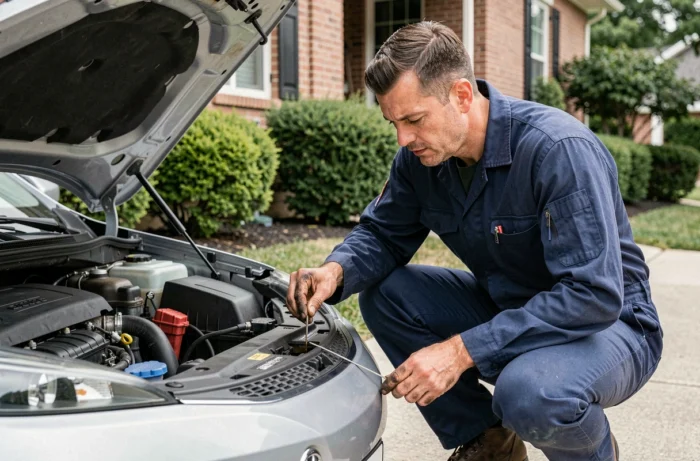
Check the oil level on level ground, with the engine switched off for at least ten minutes so the oil can drain back into the sump. The level should be between the “min” and “max” marks on the dipstick. A level that is too low accelerates internal engine wear, while overfilling can cause excessive pressure.
Check the coolant level when the engine is cold. A low coolant level can cause the engine to overheat within minutes, especially in summer or in traffic jams. The expansion tank also has min/max markings.
Brake fluid and power steering fluid
Brake fluid is hygroscopic: it absorbs moisture from the air over time, lowering its boiling point and reducing braking effectiveness. The manufacturer’s maintenance schedule generally calls for it to be replaced at set intervals, regardless of mileage. The power steering fluid reservoir, meanwhile, has two separate reference marks for when the engine is hot or cold.
Filters (air, cabin and fuel) have replacement intervals specific to each model. A clogged air filter increases fuel consumption and reduces engine performance. Checking the service record is the most reliable way to avoid exceeding the recommended intervals.
Tyres and brakes: two often-overlooked safety essentials
Tyres are the vehicle’s only point of contact with the road. Their condition affects braking distance, cornering grip and handling on wet surfaces.
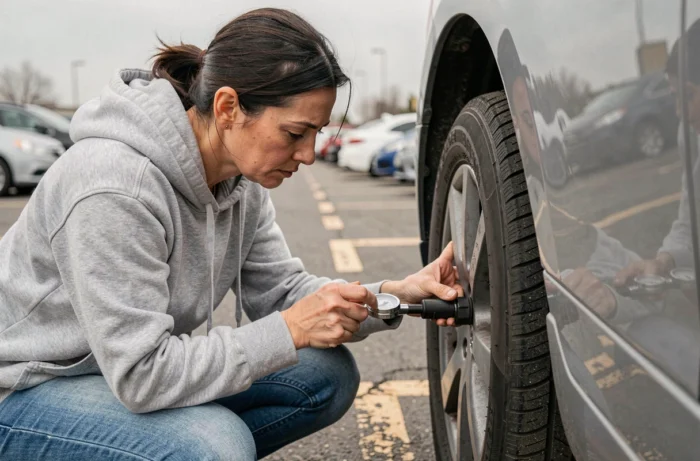
- Check tyre pressure when the tyres are cold, at least once a month. Underinflation increases rolling resistance, fuel consumption and uneven tread wear.
- The minimum legal tread depth is indicated by wear bars moulded into the tyre sidewall. When the tread reaches the level of these indicators, the tyre must be replaced.
- The condition of the sidewalls matters just as much as the tread: bulges, cuts or cracks weaken the structure and increase the risk of a blowout.
In electric and hybrid vehicles, regenerative braking slows brake pad wear, but it does not remove the need to check the mechanical braking system regularly. Discs can warp or corrode when they are not used enough—a paradox specific to these powertrains.
Electric vehicles: different maintenance, not no maintenance
Without engine oil changes or an exhaust system, some maintenance tasks are simpler, but electric vehicles still have components that should not be overlooked.
- Tyres often wear faster because of the instant torque delivered by the electric motor. Regularly rotating them between axles helps extend their service life.
- The air conditioning system uses a refrigerant circuit that requires periodic checks, just like in a petrol or diesel vehicle.
- Suspension components, bearings and ball joints are subject to the same mechanical stresses, sometimes compounded by the greater weight of the batteries.
- The mechanical braking system, used less thanks to regenerative braking, can suffer from corrosion if the discs are not engaged regularly.
Each electric model has its own manufacturer-defined service schedule. Skipping it on the grounds that “there’s no oil to change” can lead to failures in peripheral components that would have been detected during a routine inspection.
Parts from the circular economy: a consumer right governed by law
The French Consumer Code requires automotive repairers to offer customers the option of choosing parts from the circular economy in the relevant categories. In practice, this includes items such as lights, body panels and certain reconditioned mechanical components.
There are exceptions. A repairer may not offer this option if the part is unavailable within a timeframe compatible with the vehicle’s downtime, or if using it would pose a safety risk. Customers retain the right to request these parts, and the professional must inform them of this option.
This measure is about more than price. Using reconditioned parts in the repair process reduces reliance on new-part inventories, which have faced longer supply times in recent years for certain models.
Vehicle maintenance is less about following a checklist of tasks than about sticking to the intervals set by the manufacturer and keeping a record of every service. Keeping invoices, checking fluids using the correct procedure, and monitoring the actual wear of tyres and brakes rather than relying on theoretical mileage: these habits protect both your vehicle and your wallet.