France has a growing proportion of elderly people living at home, with daily realities that vary according to health status, degree of autonomy, and available support. Understanding the daily lives of seniors requires moving beyond general discussions about aging well to examine what concretely structures their days: medical follow-up, relationships with caregivers, use of digital tools, and safety devices that support their home care.
Telemedicine and telecare: what really changes in the health monitoring of seniors
Medical teleconsultation reimbursed by Health Insurance since 2018 has changed the way seniors manage their chronic illnesses on a daily basis. For a person with reduced mobility, not having to arrange transportation to the medical office represents a concrete gain, not just in comfort, but in regularity of follow-up.
Telecare, authorized in France since 2019, adds an additional dimension. Rehabilitation sessions or pharmaceutical assessments can take place remotely, supervised by medical assistants. For a senior coming out of hospitalization, this means that recovery starts earlier and continues without interruption of care.
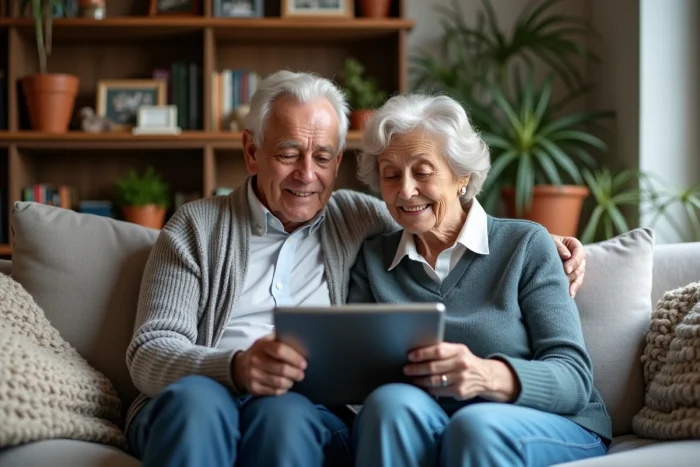
Field feedback varies on this point: some seniors quickly adopt these tools when a relative assists them with the technical aspects, while others remain reluctant due to lack of suitable equipment or reliable connection. The tool exists, but its real accessibility depends on the context of each household. To discover senior life on Vis ma Vie de Senior, concrete testimonials allow for measuring these gaps between technological promise and daily practice.
Home helpers and social connection: the pivotal role of caregivers
The home helper is no longer just the person who assists with daily tasks (hygiene, meals, maintenance). Professionals in the sector observe that helpers are increasingly using digital tools as mediators of connection with family: video calls, messaging, shared photos.
This shift changes the very nature of the intervention. The helper becomes a link between the senior and their surroundings, sometimes geographically distant. The trust relationship built day by day with home assistance largely conditions the well-being of the elderly person.
What field testimonials reveal
Several feedback reports published by service providers show that the quality of human relationships takes precedence over the technicality of the gesture. A senior who sees the same helper regularly feels safer than a senior faced with a constant turnover of caregivers.
Staff stability remains a point of friction in the sector. The available data do not allow for conclusions about the exact extent of the problem, but testimonials converge: relational continuity is the primary factor of satisfaction expressed by elderly individuals maintained at home.
Teleassistance and connected devices: continuous presence in daily life
Teleassistance has significantly evolved in recent years. New generation teleassistance solutions combine call buttons, geolocation, and automatic fall detection, introducing a form of continuous monitoring in the daily life of seniors.
The paradigm shift is notable. These devices are no longer used solely in emergencies. Some include regular exchanges with listeners, creating a scheduled human contact during the day. For a person living alone, this daily call structures time and breaks a sometimes burdensome routine.
- The classic call button, worn as a pendant or on the wrist, remains the most widespread and simplest device for seniors who are not comfortable with technology
- Geolocation reassures families whose elderly relative maintains an active life outside, especially in cases of early cognitive disorders
- Automatic fall detection, through sensors or algorithms embedded in a watch, triggers an alert without action from the wearer, covering situations where the person is unconscious or disoriented
Limitations and points of caution
The acceptance of the device by the senior themselves remains a topic. Wearing a call button means accepting one’s vulnerability, which sometimes leads to rejection, especially among those still autonomous. Support during this stage, by family or a professional, is an integral part of the process.
However, once the device is adopted, feedback is generally positive. The feeling of security reduces anxiety related to the risk of falling, which is one of the leading causes of loss of autonomy among elderly individuals.
Physical activity and nutrition: the pillars of maintaining seniors’ autonomy
Healthy aging relies on daily habits whose effects are measured over the long term. Adapted physical activity and a balanced diet are the two most documented levers in preventing loss of autonomy.
Collective workshops offered by pension funds or municipalities allow seniors to engage in supervised activities: walking, gentle gymnastics, balance. These programs also serve a social function, as they create regular appointments and opportunities for meeting.
- Fall prevention workshops combine balance exercises, muscle strengthening, and home adaptation advice
- Nutrition programs target malnutrition, a risk often underestimated among elderly people living alone
- Cognitive activities (memory games, reading, creative workshops) complement the physical approach to maintain overall capabilities
The goal is not to turn every senior into an athlete, but to maintain a sufficient level of activity to preserve functional autonomy. Getting up, walking to the mailbox, preparing a meal: these daily gestures directly depend on physical condition.
The daily life of seniors in France is not merely a medical issue or a technological question. Quality of life at home hinges on the interplay between regular health monitoring, reliable human presence, and safety devices accepted by the individual themselves. Each situation remains unique, and the solutions that work are those that stem from the real habits and needs of the elderly person, not from a standardized model.