
A ride or a motorcycle trip relies on three technical parameters: the mechanical condition of the machine, the suitability of the equipment for the planned route, and knowledge of the regulatory constraints of the journey. Neglecting any of these aspects turns a pleasant outing into a source of complications, sometimes costly.
Low Emission Zones and Tolls: the Regulatory Constraints of Motorcycle Routes
Competitors talk a lot about mechanical preparation and itinerary, but very little about the administrative pitfalls that now line the routes in France and Europe. Yet, this is where the unpleasant surprises are concentrated.
In France, crossing a LEZ on a motorcycle requires local verification, not just a glance at your Crit’Air sticker. The perimeter, hours, and exemptions are defined by municipal decree and vary from one urban area to another. A pollution episode can also trigger temporary restrictions that add to the permanent regulations.
For cross-border trips, the situation becomes more complicated. Some European countries impose a toll sticker on motorcycles, others exempt them, and still others charge by the segment. Specialized resources like Au Petit Motard provide information on the motorcycle world before finalizing your itinerary. Checking the toll regime of the destination country before departure helps avoid discovering the rule at the first checkpoint.
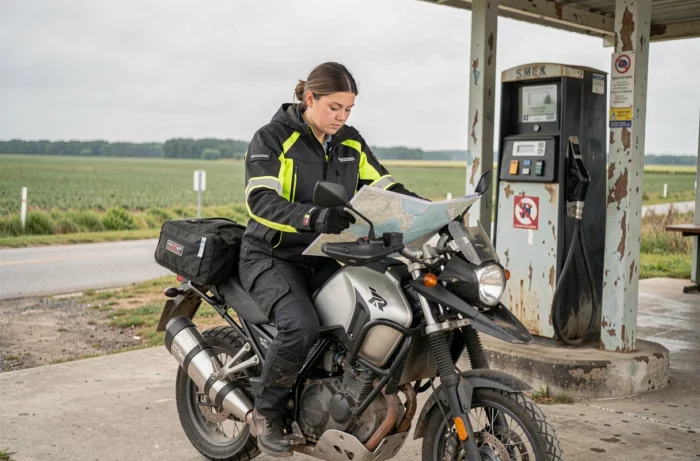
Mandatory Motorcycle Equipment: What the Law Really Requires
Motorcycle safety equipment in France is not limited to an approved helmet. For several years, the regulatory framework has expanded, and the fines associated with violations are not symbolic.
Elements Required by the Highway Code
- Approved ECE 22 helmet: mandatory for the rider and the passenger, properly fastened.
- CE certified gloves: mandatory, they must bear the visible CE marking. The absence of gloves also results in a fine.
- High-visibility vest: it must be accessible (not at the bottom of a suitcase) to be put on in case of an emergency stop. Its absence in the onboard equipment is punishable.
Beyond the Legal Minimum
The law sets a minimum standard, not a protection goal. A jacket with back and elbow protectors, reinforced pants, and high boots are not mandatory, but they significantly reduce the severity of injuries in case of a fall. Adapting your equipment to the season and the duration of the trip is as much about mechanical sense as it is about comfort.
Loaded Motorcycle on the Road: Behavior and Limits to Know
Riding with side cases, a top case, and a passenger profoundly changes the dynamic behavior of the motorcycle. This topic deserves more than a generic paragraph on “properly distributing weight.”
The center of gravity rises and moves back as soon as you load the rear. The suspensions sink more, the ground clearance decreases, and the maximum lean angle in a turn is reduced. On a mountain road with tight bends, this difference is felt from the first hairpins.
Braking also changes. The stopping distance increases notably, and the distribution between front and rear brakes must be recalibrated mentally. On a loaded motorcycle, a too-brutal front brake can cause a much more pronounced unloading of the rear wheel than when empty.
Before each trip, it is useful to check tire pressure according to the load (the values are usually found on a manufacturer label or in the manual). Most motorcycles provide for adjusting the rear shock preload: adjusting the preload to the total weight on board stabilizes handling.
Managing Fatigue on Long Motorcycle Trips
Fatigue on a motorcycle has a particularity compared to a car: it combines physical exertion (postural maintenance, vibrations, wind) and sustained mental concentration, without the possibility of relaxing attention even for a second.
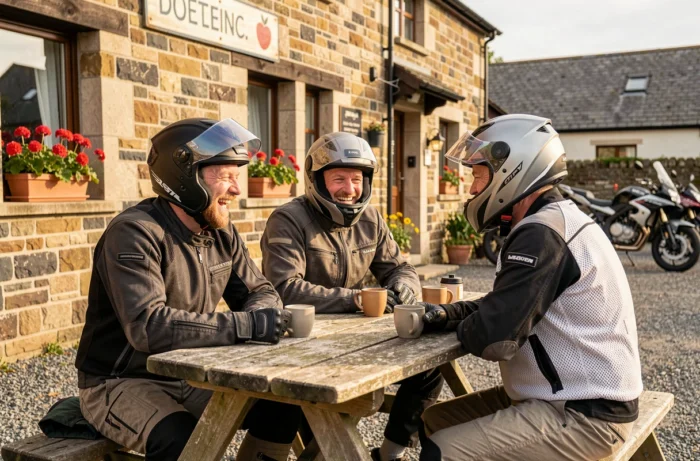
Planning regular breaks is not enough. What matters is their quality. A five-minute break with the engine running in a noisy area does not have the same effect as a fifteen-minute stop in the shade, with the helmet off, and proper hydration.
The first signs of fatigue often go unnoticed: a gaze that fixes on a point instead of scanning the road, a trajectory that drifts slightly in a turn, a delayed reaction to a traffic light change. Learning to recognize these signals before they become critical is part of driving competence, just like emergency braking.
The weather amplifies fatigue. Riding in the rain for two hours consumes as much energy as half a day in good weather, due to visual strain and heightened vigilance on grip. In extreme heat, dehydration directly affects reaction times.
Preparing for a motorcycle trip or ride is not just about a mechanical checklist. Knowing local regulatory constraints, mastering the behavior of a loaded machine, and being able to read fatigue signals are three skills that are acquired trip after trip. A motorcyclist who rides safely is first and foremost a motorcyclist who has learned to stop at the right moment.