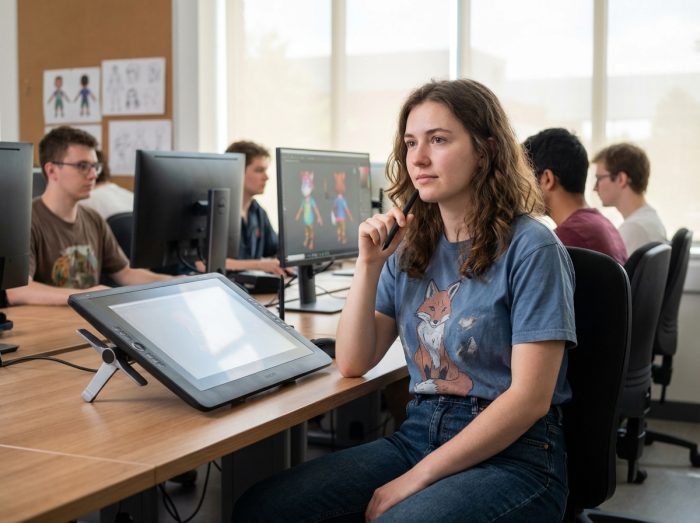
The 3D animation sector demands a rigor that is rarely mentioned during open house days. Contrary to a common belief, mastering software does not guarantee ease or stable employment. Deadlines are tightening, competition remains fierce, and technological evolution requires continuous learning, which can sometimes be frustrating.
Studios expect, beyond technical skills, an ability to collaborate and accept criticism. Mental endurance proves to be as crucial as creativity. Before enrolling, certain fundamental aptitudes deserve to be identified.
Why 3D Animation is Attracting More and More Young Creatives
3D animation is everywhere: on cinema screens, in video games, advertising, and even in medical applications. The era when only a few ultra-elite studios mastered the discipline is over. Now, an entire generation dreams of participating in these new digital universes. France, driven by Paris and its renowned schools, is not just riding the wave: it is shaping it, training artists who are recognized internationally for the precision of their education and the success of their productions.
In daily life, studying at a 3D animation school goes far beyond mastering complex software. One imagines characters, builds sets, and literally shapes entire worlds. Job opportunities abound: 3D animator, graphic designer, game designer, technical artist, motion designer… Each of these professions requires juggling modeling, storyboarding, animation, and special effects. Staying versatile is not a luxury but a necessity given the sector’s developments.
Many are initially attracted by the prospect of bringing an animated film to life, making an impact in advertising, or immersing players. Others venture into teaching or scientific applications. However, as the curriculum progresses, some quickly discover that the qualities necessary for success in 3D animation make all the difference: patience, rigor, curiosity, and teamwork become essential supports for enduring without bending.
The image one has at the beginning often clashes with reality: learning takes time, one must be involved at every moment, accept frank criticism, and revise work until reaching the right version. If there is one constant, it is that passion, over the long term, is measured by the ability to hold on when everything becomes demanding.
Asking the Right Questions: What You Really Need to Love to Thrive in This Profession
Taking the time to reflect is crucial: do you have a taste for the creative process, an appetite for detail? This field does not accept superficiality: it demands investment in design, meticulous prototyping, and perseverance when it comes to refining each scene or character. Modeling a face or animating a gesture requires genuine curiosity about mechanisms, movements, and the logic of a story to be structured shot by shot.
Many spend hours in front of the screen trying, correcting, and restarting, and some find their comfort zone there. Professional tools are not intuitive: one must be willing to seek, learn, experiment, and accept to question oneself after sometimes direct feedback from the team or contributors. Drawing, inventing, failing, restarting: this sequence is an integral part of the journey.
Teamwork occupies a central place: it is about building collectively, exchanging ideas, defending a choice, or knowing when to abandon it for the sake of the common project. Profiles that thrive are those who appreciate this dynamic and place collaboration on the same level as technical mastery.
To progress, curiosity remains your best ally. Keeping up with new software, discovering the work of other artists on LinkedIn or Instagram, regularly testing new techniques: these are all reflexes that enrich each person’s journey and help distinguish oneself over time.
Resources, Schools, and Pathways: How to Prepare for Your Future as a 3D Animator
From the start, preparing a solid portfolio will make all the difference. This graphic dossier reflects:
- your versatility through a variety of personal projects;
- your ease in observational drawing, digital creations, or experiments;
- your ability to renew yourself and show a strong visual identity.
In France, schools dedicated to 3D animation often offer programs lasting three to five years, accessible right after high school. Having prior artistic training can really make a difference. Admission varies by institution: Parcoursup, competitive exams, motivation interviews. In each selection, recruiters look for profiles capable of combining inventiveness and technical know-how from the outset. Even before entering school, preparatory classes or specialized preparatory courses offer a concrete testing ground to evaluate oneself and progress in practice.
To structure one’s journey, here are the diplomas one can aim for:
- Bachelor in 3D Animation (RNCP level 6): fundamental base in drawing, modeling, motion design
- Master’s in 3D Animation (RNCP level 7): advanced training with a choice of specialties like VFX or technical art
Work-study programs, valued at the master’s level, quickly connect students with the realities of the studio and production sets. Internships, which are essential, open the door to the professional world: cinema, video games, advertising. They serve as an experience accelerator to refine one’s orientation choices.
A strong alumni network carries significant weight: it offers opportunities, advice, and direct insight into the job market. Some schools report impressive employment rates: up to 92% six months after graduation. Success in this highly dynamic market depends on the balance between artistic ability, practical experience, and a reliable professional network.
For those wishing to engage in this field of expression, the sector never offers two identical paths. Each individual must create their own journey, image by image, until leaving their mark in the digital sphere.